> For the complete documentation index, see [llms.txt](https://vaultbook.gauntlet.xyz/llms.txt). Markdown versions of documentation pages are available by appending `.md` to page URLs; this page is available as [Markdown](https://vaultbook.gauntlet.xyz/introduction/defi-101-vaults-and-curators/curators-101.md).
# Curators 101
{% hint style="success" %}
**A vault curator is the entity that designs, configures, and oversees a vault.**
{% endhint %}
A crucial difference between DeFi strategies and traditional off-chain strategies is that DeFi vault curators never take custody of user assets. DeFi’s non-custodial nature enables users to retain control of their funds at all times, and its programmatic nature encodes in every smart contract the actions that curators can and cannot perform with user assets.
### **Actions curators can take**
On a particular vault, curators handle the strategic and risk management decisions that impact vault performance. Our mandate is straightforward but crucial: protect suppliers first, then maximize safe, scalable yield.
**Market allocation and risk parameters (lending example)**
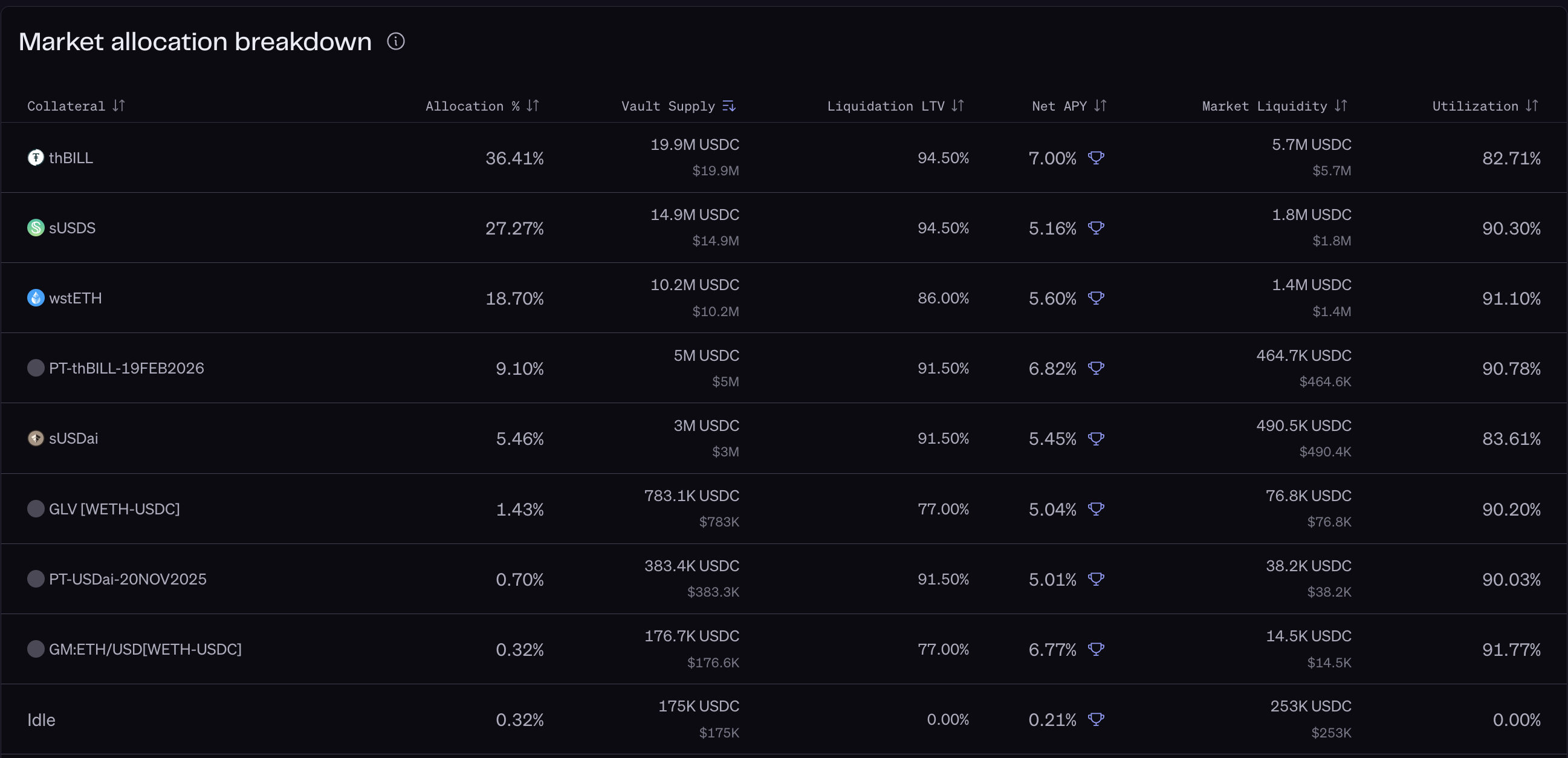
* **Market allocation:** In a lending vault, curators select which borrow markets to include in a vault and allocate user supply between them based on a set strategy.
* **Market supply caps:** Set supply caps on each market allocated to the vault to balance risk and yield. These caps set limits on how much vault supply can be allocated to a particular market.
* **New market LLTVs:** Configure [LLTV (Liquidation Loan-to-Value)](/vaults/morpho-vaults/vault-curation-considerations-a-deeper-dive/liquidations-and-liquidators.md) ratios based on asset volatility, DEX liquidity depth, and oracle nuances. When spinning up a new market, we set LLTVs to ensure that any loan positions taken out against vault supply are sufficiently over-collateralized.
**Active risk management**
* Raise or lower vault caps based on market signals: improved DEX depth, sustained borrow demand from diverse borrowers, and proven liquidation performance in stress events.
* Rebalance allocations to optimize risk-adjusted yield as market conditions change.
{% hint style="info" %}
[Explore the details of our curation methodology and risk management approach](/vaults/morpho-vaults/curation-methodology-and-risk-factor-overview.md).
{% endhint %}
### **Actions curators cannot take**
The limitations placed on curators are just as important as the actions we can take.
* **Curators cannot execute supply or withdrawal transactions that move funds on- or off-platform**: At no point in the curation lifecycle do curators have the authority to withdraw user funds. This means that wherever vault supply is allocated, a supplier can withdraw funds (subject to available liquidity).
* **Curators cannot block users from withdrawing funds:** the ability for a user to unilaterally withdraw funds from a vault is encoded in the vault smart contract. *Note:* During market utilization spikes (which may occur as a result of adverse market conditions), withdrawals may be delayed.
{% hint style="info" %}
[Read more on how our vaults fared during a recent period of market turmoil and liquidity stress](https://www.gauntlet.xyz/resources/market-report-liquidity-stress-period-nov-2025).
{% endhint %}
### **Why expertise matters: The case for professional curation**
Effective vault curation requires specialized knowledge across multiple domains:
**Risk modeling and market analysis**
Curators must have an understanding of how to balance risk with capital efficiency. For example, markets with higher LLTVs naturally attract more borrowers since borrowers get access to higher leverage. However, higher LLTVs give less room for error during adverse market conditions. The role of a curator is to find the appropriate balance that drives risk-adjusted yield.
**Collateral analysis and due diligence**
Our vaults adhere to rigorous risk management guidelines to enhance resilience against market volatility. This begins with an extensive [due diligence evaluation](/vaults/morpho-vaults/curation-methodology-and-risk-factor-overview/due-diligence.md) of collateral assets. Our curation team engages in this comprehensive analysis before adding any new market to a Gauntlet Vault. The process includes an assessment of [liquidity, security, audits, oracles, special mechanisms, and more](/vaults/morpho-vaults/curation-methodology-and-risk-factor-overview.md).
**Liquidation mechanics and DEX liquidity**
Liquidations on assets with thin DEX liquidity can trigger liquidation cascades. Deep liquidity helps facilitate liquidations as they're needed.
**Real-time risk management**
Our risk infrastructure uses simulations, real-time monitoring, and automated response systems to continuously assess market conditions. This helps us determine when to keep assets idle, when to deploy to new markets, and when to pull back.
---
# Agent Instructions
This documentation is published with GitBook. GitBook is the documentation platform designed so that both humans and AI agents can read, navigate, and reason over technical content effectively. Learn more at gitbook.com.
## Querying This Documentation
If you need additional information that is not directly available in this page, you can query the documentation dynamically by asking a question.
Perform an HTTP GET request on the following URL with the `ask` and `goal` query parameters:
```
GET https://vaultbook.gauntlet.xyz/introduction/defi-101-vaults-and-curators/curators-101.md?ask=&goal=
```
`ask` is the immediate question: it should be specific, self-contained, and written in natural language.
`goal` is what the user is ultimately trying to achieve, the reason they need the answer. Sharing it helps GitBook give you a better, more relevant answer. A goal is most helpful when it describes the outcome the user wants rather than restating the question. For example, with `ask=how do I create an API token`, a goal like `build a script that syncs our docs to a CMS` lets GitBook tailor the answer to that use case.
The response will contain a direct answer to the question and relevant excerpts and sources from the documentation.
Use this mechanism when the answer is not explicitly present in the current page, you need clarification or additional context, or you want to retrieve related documentation sections.