> For the complete documentation index, see [llms.txt](https://vaultbook.gauntlet.xyz/llms.txt). Markdown versions of documentation pages are available by appending `.md` to page URLs; this page is available as [Markdown](https://vaultbook.gauntlet.xyz/resources/market-volatility.md).
# Market Volatility
How have Gauntlet vaults performed during extreme market events?
## **Liquidity Stress and Stream xUSD Insolvency (Oct. - Nov. 2025)**
Read our liquidity stress report
**Summary**
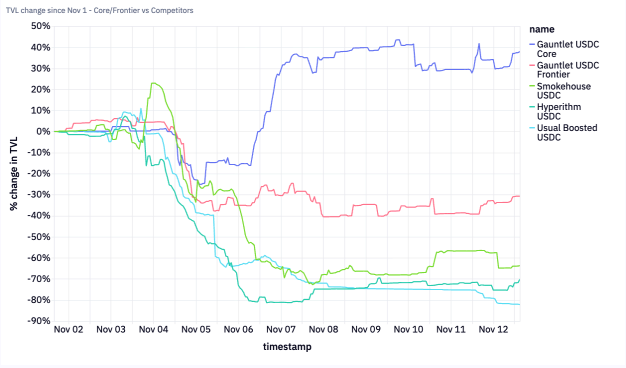
From mid-October through early November, DeFi faced among its most significant solvency and liquidity shocks to date, including the largest liquidation event in its history and the subsequent Stream (xUSD) insolvency.
On November 4, 2025, Stream Finance disclosed a $93M loss tied to an external fund manager overseeing part of xUSD’s backing, prompting an immediate pause on redemptions and supplies. With redemptions frozen, xUSD holders could only exit via secondary markets, driving the price down to \~$0.94–$0.88 within hours. xUSD liquidity migrated to safer stablecoins and vaults with robust risk management.
The incident occurred weeks after the October 10 liquidation event, in an environment with lower trading liquidity, tighter risk appetite, and elevated sensitivity to any solvency headlines.
**Gauntlet Risk Management Actions**
Following the market volatility on October 10, Gauntlet’s curation team proactively assessed\
potential latent risks across all vault exposures. Anticipating the possibility of undisclosed\
insolvencies, we conducted a comprehensive review of all assets that could have been\
affected under a worst-case contagion scenario and strategically exited markets that exhibited\
elevated counterparty or asset-backing risk.
As news of xUSD losses came to light, we reviewed our collateral universe to exit any directly affected markets. The primary assets that had solvency concerns were deUSD, sdeUSD, and mHYPER. We already had zero exposure to these assets in all of our vaults.
**Result**
Gauntlet vaults did not accrue any insolvent debt.
Gauntlet’s USDC Vaults demonstrated strong relative resilience compared to peer vaults. USDC Balanced TVL increased by 35%. Frontier declined by 20%, while other curated Morpho Vaults experienced TVL drawdowns exceeding 60%.
***
## **ByBit Exploit (February 2025)**
**Summary**
On Feb 21, 2025, ByBit was hacked for 500K ETH due to an exploit on SAFE’s multisig frontend.
The primary risk to Morpho vaults was through Ethena token exposure, given that ByBit is one of the CEXs where Ethena takes short perpetual positions. ETH exposure was not a concern.
**Gauntlet Risk Management Actions**
Proactively reallocated $28.9M from potentially affected markets: $16.7M from PT-sUSDE/USDC markets in the Gauntlet USDC Balanced vault and $12.2M from PT-USDe and PT-sUSDE markets in the Gauntlet DAI Balanced vault out of an abundance of caution.
Acted preemptively despite Ethena Labs reducing its PnL exposure from an initial <$30M to $0 and confirming that none of its stablecoin's backing assets were custodied on Bybit.
Confirmed that ongoing Safe frontend issues had no impact on our vault operations. Implemented an internal multisig transaction checking tool to verify transaction hashes independently, eliminating reliance on the Safe frontend which displayed incorrect transaction hashes during the exploit.
[Read more.](https://x.com/gauntlet_xyz/status/1893029338368614776)
**Result**
Gauntlet vaults did not accrue any insolvent debt.
***
## **Usual Money Redemption Mechanism Adjustment Event (January 2025)**
**Summary**
Usual Money offers two stablecoins: USD0, a tokenized Treasury bill-backed stablecoin, and USD0++, a liquid staked version of USD0 with a four-year lock-up. Originally, Usual Money offered a 1:1 instant redemption from USD0++ to USD0, which allowed users to bypass the four-year lockup.
On Jan 9, 2025, Usual Money [announced](https://usual.money/blog/usual-s-next-leap-solidifying-a-4-year-horizon-for-sustainable-growth) they were updating their terms on the USD0++ to USD0 redemption window to a 0.87 price floor and an early unstaking mechanism that would be released in the following days.
USD0 and USD0++-related Morpho markets were only allocated in the Gauntlet USDC Balanced vault given that the assets and underlying protocol smart contracts were not yet battle-tested.
**Gauntlet risk management actions**
Within 5 minutes of Usual's updated terms announcement, which triggered the eventual depeg of USD0++ from its 1:1 with USDC and other stablecoins, our team was wargaming likely outcomes and responses. Gauntlet was the first to release a full quantitative assessment of the situation and outline our actions to protect our vault suppliers.
Between 9:46pm on 2025-01-09 and 4:02am on 2025-01-10, we executed a series of nine transactions that withdrew all funds from the affected markets, eliminating all of our exposure to USD0++-related assets.
[Read more](https://x.com/gauntlet_xyz/status/1877825680756613372).
**Result**
Gauntlet vaults did not accrue any insolvent debt.
***
## **ezETH Market Volatility (April 2024)**
**Summary**
On April 24, 2024, ezETH experienced a liquidity crunch with a market price drop starting at 2024-24-04 02:25 UTC.
Only the highest risk ezETH/WETH/0.86 LLTV market accrued insolvencies (10.96 WETH), with 7.12 WETH (11 basis points of yield) socialized to the Gauntlet LRT Balanced vault. The lower LLTV markets (0.77 and 0.625) experienced no losses. LRT Balanced suppliers in the vault for more than two days were net positive in their supply position given accrued interest.
**Gauntlet risk management actions**
Prior to this event, our risk-balanced allocation strategy distributed WETH across three LLTV tiers: 5k WETH in the highest yield 0.86 LLTV market, 2k WETH in the 0.77 market, and 400 WETH in the 0.625 market. This tiered approach contained potential losses while maintaining exposure to higher yields.
**Result**
The Gauntlet LRT Balanced vault (now Gauntlet WETH Balanced), designed to capture higher-risk yield opportunities for users with a greater risk appetite, delivered an annualized yield of \~27% in the weeks preceding the event. As shown in the conversion chart, this substantial yield significantly outpaced the 11 basis point socialized loss during the volatility event.
---
# Agent Instructions
This documentation is published with GitBook. GitBook is the documentation platform designed so that both humans and AI agents can read, navigate, and reason over technical content effectively. Learn more at gitbook.com.
## Querying This Documentation
If you need additional information that is not directly available in this page, you can query the documentation dynamically by asking a question.
Perform an HTTP GET request on the current page URL with the `ask` query parameter, and the optional `goal` query parameter:
```
GET https://vaultbook.gauntlet.xyz/resources/market-volatility.md?ask=&goal=
```
`ask` is the immediate question: it should be specific, self-contained, and written in natural language.
`goal` is optional and describes the broader end goal you are ultimately trying to accomplish on behalf of the user. GitBook uses it to tailor the answer towards what is most useful for that goal.
The response will contain a direct answer to the question and relevant excerpts and sources from the documentation.
Use this mechanism when the answer is not explicitly present in the current page, you need clarification or additional context, or you want to retrieve related documentation sections.
.png?alt=media&token=335ba6e5-c5f5-4690-ac33-fadf32aa3821)